





Where have all the big servers on the ATP Tour gone?

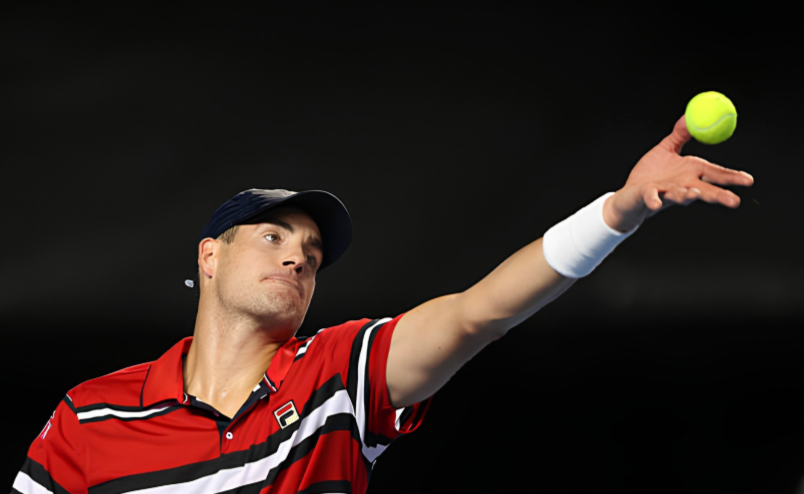
Since the early years of the ATP Tour, power has become an increasingly important part of the men's game, and few areas have reflected that more than the serve.
Through the 1990s and 2000s, the biggest servers became increasingly prolific, and ace counts at the top of the game reached remarkable levels in the 2010s.
Players such as Goran Ivanišević helped drive that rise early, before Ivo Karlović and John Isner took it to another level in the years that followed.
But in recent years, that long-running trend has started to change.
The First Serve analyses ATP serving statistics at five-year intervals from 1991 through to 2026 to track the rise of the game's biggest ace producers, the gradual shift that followed and the sharp decline at the very top in recent years.
The rise and fall of the leading ace producer
To see how far the biggest serving numbers have moved, we first looked at the player who led the Tour in average aces per match in each of the years analysed.
1991: Goran Ivanišević - 10.3 aces per match
1996: Goran Ivanišević - 15.3
2001: Goran Ivanišević - 16.7
2006: Ivo Karlović - 18.0
2011: Ivo Karlović - 17.6
2016: John Isner - 23.2
2021: John Isner - 20.6
2026: Giovanni Mpetshi Perricard - 15.9
Listen to The First Serve Live every Monday at 8pm AEDT in its 18th year on the SEN Network/App, Australia's only dedicated weekly tennis program on commercial radio.
Even just looking at the individual leaders, the progression is obvious. Ivanišević led the charge from 10.3 to 16.7 over the first decade, Karlović pushed it toward 18, and Isner eventually took it above 20, peaking at a remarkable 23.2 aces per match in 2016.
The figure began to fall in 2021, with Mpetshi Perricard leading the Tour at just 15.9 this season.
It represents a drop of more than 30 per cent from the 2016 peak and puts the 2026 leader back around the level Ivanišević was producing in the late 1990s and early 2000s.
Of course, Karlović and Isner were extreme cases even among the biggest servers, so to see whether this is a broader trend, we need to widen the sample.
The top five tell the same story
The average among the five leading ace producers in each year shows a similar rise and fall.
1991: 9.0 aces per match
1996: 13.4
2001: 13.2
2006: 12.3
2011: 14.0
2016: 17.2
2021: 14.8
2026: 13.7
Again, the high point comes in the 2010s.
In 2016, the top five were Isner, Karlović, Gilles Müller, Nick Kyrgios and Sam Querrey, with Isner and Karlović averaging more than 20 aces per match, and all five were above 13.
This year, Mpetshi Perricard leads a top five that also includes Hubert Hurkacz, Taylor Fritz, Arthur Rinderknech and Jakub Menšík.
They are all strong servers, but the average has fallen from 17.2 to 13.7 in a decade, a decline of more than 20 per cent.
Looking even further, the top 10 backs that up, falling from 14.3 aces per match in 2016 to 12.2 in 2026, a drop of 14.5 per cent.
So the decline is not simply Isner and Karlović disappearing from the top of the list. It remains clear when a much broader group of the biggest ace producers is considered.
Further down the list presents a different story
Once the sample expands beyond the very top, the decline becomes much smaller.
Top 20 ace producers: 11.6 aces per match in 2016, compared with 10.8 in 2026, a 6.7 per cent drop
Top 50 ace producers: 8.6 in 2016, compared with 8.7 in 2026, a 1.3 per cent rise
Top 80 ace producers: 6.9 in 2016, compared with 7.2 in 2026, a 4.2 per cent rise
Tickets to the 2027 Kooyong Classic are officially on sale! 🎾 12–14 January 2027. Buy your tickets here 👉 bit.ly/4xEDn7p
Across both the top 50 and top 80 ace producers, the average is actually higher now than it was at the peak of the big-serving era.
We can see that rise over time.
In 1991, Sweden's Jonas Svensson was 50th on the ace-per-match leaderboard at 3.4, compared with Illya Marchenko at 5.3 in 2016 and Matteo Arnaldi at 6.2 in 2026.
So the overall story is that the biggest ace producers are no longer separating themselves from the rest of the pack, while players further down the list are producing more.
So why is this happening?
There is probably no single answer, but several changes in the modern game could be contributing: Returners have adapted
One possibility is simply that players have become better equipped to deal with enormous serves.
As serving became more powerful, returners adapted with deeper court positions, different swings and better movement to give themselves more time and get more balls back into play.
Daniil Medvedev is an extreme example. Early in his career, he returned much closer to the baseline, but after being blown off the court by Jo-Wilfried Tsonga without creating a break point, he decided he needed to try something different.
"So the next time I played someone who served big, I would go somewhere here," Medvedev said on moving further behind the baseline. "Then I played someone who served bigger, and I would go somewhere [even further back]."
The deeper position gave him enough time to turn the return into what he described as "a normal topspin shot" rather than simply reacting to the serve.
Not every player stands as far back as Medvedev, but players are developing better ways to absorb and neutralise huge serves.
Are the balls playing a role?
The balls could also be part of it. Players have repeatedly complained that they become bigger and slower as they wear, taking pace out of the serve.
Medvedev made the point bluntly in 2023, arguing that "the serve doesn’t count as much", and also said the balls became "like apples" after only a few games.
Nadal said much the same in Brisbane in 2024: "The ball gets too big sometimes" and "it's dead". With new balls, he said, "the situation change[s] a lot".
Those complaints are still loud in 2026, with Carlos Alcaraz recently describing the balls in Shanghai as "bigger" and "a little bit slower".
What about the courts?
Court speed is another possible factor. Through the 2000s and early 2010s, there was a growing perception that conditions across the Tour had become slower and less favourable to big servers.
By 2013, Australian Open tournament director Craig Tiley argued the balance had shifted too far, admitting: "I think it has gone too much one way and the tournaments need to correct it."
But if slower courts were responsible for the decline in the biggest servers, the timing does not quite fit. Ace numbers at the very top continued to climb after those concerns were already widespread, reaching their peak three years later in 2016.
Court speed may therefore have played some role, but it is difficult to make it the main explanation for the much sharper decline that followed.
Does the modern game simply demand more?
Perhaps the final part of the answer is that it has simply become harder to survive at the top of men's tennis with one overwhelming weapon.
The traditional servebot could hold repeatedly, keep points short and rely on finding one opening on return or getting to a tiebreak.
Karlović won 96 per cent of service games in 2015 while winning just 10 per cent of return games. Isner won 94 per cent of his service games in 2019 and only 10 per cent on return.
Compare that with Jannik Sinner. In 2025, he became the first player since 1991 to lead the Tour in both service games won and return games won in the same season, winning 92 per cent of his service games and 32.6 per cent on return.
When Brad Gilbert asked Isner whether those serving numbers now made Sinner a servebot, Isner's response summed up the difference.
"Not a bot when you return like that," said the American.
Perhaps that is where the game has moved.
The best players still serve enormously well, but the serve is increasingly the opening shot of a dominant pattern rather than the entire game. A Sinner or Carlos Alcaraz does not necessarily need an ace if the first serve produces a weak return and leaves an easy next ball.
The big serve has not disappeared. In many ways, more players have one than ever before.
What has become much harder to find is the player who sits miles above everyone else and can build so much of his game around one overwhelming shot.
ML Tennis delivers world-class coaching and structured player pathways for athletes of all ages and levels — from grassroots participation through to aspirational and high-performance players.
Led by Player Development Specialist Coach Michael Logarzo, ML Tennis is recognised as a Tennis Australia Talent Hub and operates across multiple venues throughout Melbourne.
Supported by an expert coaching team, ML Tennis delivers structured programs, a proven record of player progression, and an athlete-driven culture that supports every player to build their own tennis journey.
Visit – www.michaellogarzotennis.com.au


Comments